



Benefits of Jojoba Oil for Hair: Moisture, Shine, Scalp Support , and What Science Shows
Botanical Brilliance
Jojoba is commonly called an oil, but it is chemically a liquid wax rich in long-chain wax esters. Research supports its role as an emollient and formulation ingredient, while evidence for hair regrowth remains absent.

Botanical identity
The physician’s answer
Does jojoba actually benefit the hair and scalp?
Yes—but primarily as a cosmetic and supportive ingredient.
Jojoba may help dry, weathered strands feel softer and easier to manage. Its surface-lubricating properties may reduce friction during detangling and styling, while its wax esters may help support moisture at the scalp surface. These roles can make jojoba a useful addition to a thoughtful hair care routine, particularly when it is incorporated into a well-designed conditioner or leave-on formula.
Preliminary human-skin and laboratory findings also suggest barrier-supportive and inflammation-modulating activity. However, jojoba has not been proven to activate hair follicles, increase human hair density, or treat pattern baldness.
At-a-glance summary
- Jojoba “oil” is technically a liquid wax composed predominantly of long-chain wax esters.
- The wax is extracted from the seeds of the jojoba plant.
- Its functional constituents include wax esters, long-chain fatty-acid and fatty-alcohol structures, tocopherols, and phytosterols.
- A small human study supports moisturization from hydrolyzed jojoba esters combined with glycerol.
- Ex-vivo human-skin research suggests possible anti-inflammatory and barrier-supportive activity.
- Laboratory findings support skin-cell repair mechanisms, not hair-follicle stimulation.
- The best-supported hair roles are softness, lubrication, manageability, and improved surface feel.
- There is no persuasive human evidence that jojoba regrows hair.
Meet the botanical
The jojoba plant is a drought-adapted evergreen shrub native to arid areas of the southwestern United States and northern Mexico. Its seeds contain a high proportion of liquid wax. Although this material is commonly called jojoba oil because it remains liquid at room temperature, it differs substantially from conventional triglyceride oils.
Jojoba consists predominantly of long-chain wax esters, with smaller quantities of free fatty acids, fatty alcohols, sterols, tocopherols, and hydrocarbons. This structure helps explain its strong resistance to oxidation, smooth spread across the skin and hair, and relatively light sensory profile.

Main bioactives and functional constituents in jojoba
Jojoba differs from bergamot, rosemary, and peppermint. Its central cosmetic activity does not come from a volatile essential oil dominated by aromatic terpenes. Instead, its defining constituents are long-chain wax esters, supported by smaller quantities of antioxidant and sterol compounds.
Long-chain wax esters
Jojoba liquid wax is composed mainly of esters formed by joining long-chain monounsaturated fatty acids with long-chain fatty alcohols. Reported wax esters include docosenyl eicosenoate, eicosenyl eicosenoate, eicosenyl docosenoate, docosenyl docosenoate, eicosenyl oleate, and docosenyl oleate.
These molecules explain jojoba’s physical and cosmetic behavior. They have not been clinically shown to stimulate human follicles.
Simmondsin and seed-extract compounds
Simmondsin is associated principally with jojoba seeds and seed meal. The supplied pancreatic-cell study evaluated isolated simmondsin and an aqueous jojoba seed extract—not the cold-pressed topical wax used in most cosmetic hair products. Those results should not be transferred to the scalp or to finished hair-care formulas.
Historical and cultural context
Historical accounts describe Indigenous communities in Baja California and the Sonoran region crushing or heating jojoba seeds to prepare a salve-like material for skin and hair. Jojoba became associated with grooming, softness, and protection from dry desert conditions.
Traditional use is culturally meaningful, but it does not prove that jojoba treats inflammatory scalp disease, prevents shedding, or stimulates follicular growth. Modern interest expanded because jojoba offered a stable, plant-derived wax suitable for cosmetic, pharmaceutical, and industrial formulations.
What the science actually shows
For broader context on the difference between oxidative mechanisms and demonstrated hair outcomes, read Oxidative Stress and Hair Loss.
Hair, scalp, and strand relevance
Scalp moisture and comfort
The scalp barrier regulates water loss and protects against environmental exposure. Frequent washing, dry air, heat, and aggressive cleansing can leave some people with tightness or discomfort. Jojoba’s wax esters may form a flexible surface film that supports moisture retention and comfort.
Natural sebum: similar, but not identical
Jojoba is often compared with natural sebum because both contain wax esters. That comparison is directionally reasonable, but the materials are not chemically identical. There is no strong clinical evidence that applying jojoba causes the sebaceous glands to produce less oil or permanently “balances” scalp oil production.
Strand lubrication and hair cuticles
The visible hair fiber is nonliving. A topical formula cannot biologically heal it, but it can alter how the surface feels and behaves. Jojoba may improve slip, reduce a rough or brittle sensation, support the appearance of shiny hair, and reduce friction during combing that can contribute to hair breakage.
Curly and coily hair
A jojoba-containing conditioner or styling formula may be useful for curly or coily hair when additional slip and softness are desired. Performance depends on the complete formula, porosity, density, styling method, and the quantity applied.
Jojoba compared with coconut oil
Jojoba is primarily a liquid wax made from long-chain esters. Coconut oil is primarily a triglyceride material. Jojoba often provides a lighter surface-conditioning feel, while coconut oil may feel richer. One is not universally superior.
Pure jojoba does not have a meaningful pH
Because jojoba contains little to no water, it does not have a meaningful pH in the way a water-based shampoo or conditioner does. The pH of the finished formula—not the jojoba ingredient alone—is what matters.
What has not been proven
Current evidence has not established that jojoba:
- Increases human hair count or clinically measured density
- Extends the anagen growth phase
- Activates dormant follicles
- Reverses follicular miniaturization
- Blocks DHT in a clinically meaningful manner
- Treats pattern baldness, alopecia areata, or scarring alopecia
- Permanently changes sebaceous-gland output
- Treats dandruff, psoriasis, or scalp infection
- Repairs split fibers from within
For a broader explanation of how botanical support differs from proven stimulation, see Botanical Hair Growth Mechanisms.
Safety and appropriate use
Cosmetic-grade jojoba is generally well tolerated. The Cosmetic Ingredient Review Expert Panel concluded that jojoba-derived cosmetic ingredients were safe within the practices and concentrations reviewed. Individual irritation or contact allergy remains possible.
- Patch test a new leave-on formula before widespread application.
- Stop use if persistent burning, swelling, itching, or rash develops.
- Avoid application over infected, actively weeping, or open skin without medical guidance.
- Use cosmetic-grade material intended for topical application.
- Apply modestly to fine or easily weighed-down strands.
- Cleanse when residue or buildup becomes noticeable.
Cosmetic jojoba seed oil should not be placed in food or beverages. Seed meal and aqueous extracts contain compounds that are chemically distinct from the topical wax fraction.
Within the Origenere system
Origenere uses jojoba in three different formulation contexts. The presence of jojoba within a complete product does not mean that the formula duplicates the preparation, concentration, or outcome of an isolated-ingredient study.
Naturale Hair Styling Cream
A leave-on styling formula in which jojoba contributes to spreadability, softness, surface conditioning, and a flexible, non-crisp finish.
Explore Naturale Hair Styling CreamLa Rosa Shampoo
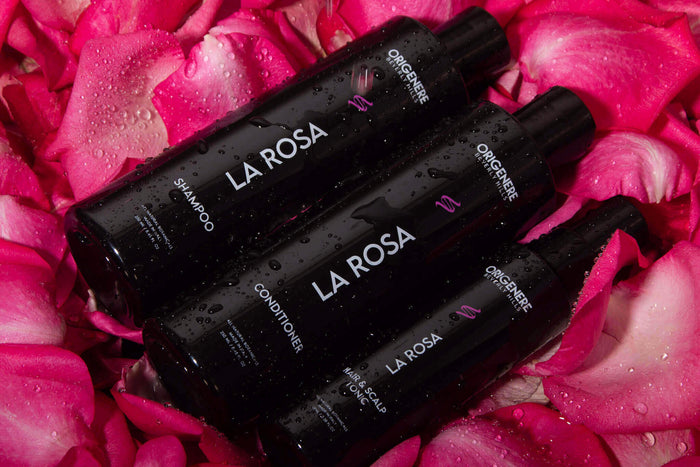
A rinse-off cleansing context in which jojoba works as part of a broader formula designed to leave the fiber feeling less stripped.
Explore La Rosa ShampooLa Rosa Conditioner
A strand-focused conditioning formula in which jojoba contributes to softness, detangling, and a smoother surface feel.
Explore La Rosa ConditionerBotanical ritual: The Desert-Silk Finish
After cleansing, apply La Rosa Conditioner primarily through the mid-lengths and ends. Leave it in place as directed, then rinse thoroughly.
On damp hair, warm a small amount of Naturale Hair Styling Cream between the palms. Distribute lightly through areas prone to dryness, roughness, or frizz.
For a separate pre-shampoo ritual, warm two to four drops of cosmetic-grade jojoba between the fingertips, smooth lightly over the driest sections, leave for 15 to 30 minutes, and shampoo thoroughly. Begin conservatively: more product may create heaviness without improving the result.
For further practical context, see Origenere’s DIY essential-oil guide. Essential oils remain concentrated and require thoughtful dilution even when jojoba is used as the carrier.

Frequently asked questions
What are the main benefits of jojoba oil for hair?
Its best-supported roles are surface conditioning, lubrication, softness, moisture support, and improved manageability. Clinical hair-regrowth evidence is absent.
Is jojoba actually an oil?
It is commonly called an oil because it remains liquid at room temperature. Chemically, it is predominantly a liquid wax made from long-chain wax esters.
Can jojoba help dry-feeling hair?
It may improve surface lubrication and reduce a rough or brittle feel, particularly within a properly formulated conditioner or leave-on styling product.
Does jojoba make hair grow?
No persuasive human trial has shown that jojoba increases hair count, density, or follicular growth.
Does jojoba treat pattern baldness?
No. Jojoba has not been shown to reverse androgen-related miniaturization or replace established medical evaluation and treatment.
Is jojoba identical to scalp sebum?
No. Both contain wax esters, but their complete chemical compositions differ. The similarity does not prove that jojoba normalizes oil-gland activity.
Can jojoba be mixed with essential oils?
It is commonly used as a carrier. Dilution reduces concentration but does not eliminate the possibility of irritation or allergy.
How much should be applied?
Begin with a few drops or follow the instructions on the finished formula. Applying more may increase heaviness and buildup without improving performance.
Can jojoba be consumed?
Cosmetic jojoba seed oil should not be consumed or placed in beverages. Topical jojoba wax and seed-extract research are separate from food use.
Final perspective
The benefits of jojoba oil for hair are meaningful when described precisely.
Jojoba is an unusually stable botanical liquid wax. Its long-chain wax esters, tocopherols, phytosterols, and associated lipid components help explain why it works well as an emollient, carrier, and surface conditioner.
Human evidence supports moisturization from a specific hydrolyzed-jojoba-and-glycerol formula. Ex-vivo human-skin research suggests inflammation-modulating and barrier-related activity. Laboratory research supports skin-cell repair mechanisms.
None of these findings proves that jojoba regrows hair.
Within a thoughtful formula, jojoba may contribute to softness, manageability, surface shine, and healthier-feeling hair without being asked to perform beyond the evidence.
References
- Gad HA, Roberts A, Hamzi SH, et al. Jojoba Oil: An Updated Comprehensive Review on Chemistry, Pharmaceutical Uses, and Toxicity. Polymers. 2021;13(11):1711. doi:10.3390/polym13111711. View source.
- Tietel Z, Melamed S, Ogen-Shtern N, et al. Topical application of jojoba wax enhances the synthesis of pro-collagen III and hyaluronic acid and reduces inflammation in the ex-vivo human skin organ culture model. Front Pharmacol. 2024;15:1333085. doi:10.3389/fphar.2024.1333085. View source.
- Meyer J, Marshall B, Gacula M Jr, Rheins L. Evaluation of additive effects of hydrolyzed jojoba esters and glycerol: a preliminary study. J Cosmet Dermatol. 2008;7(4):268–274. doi:10.1111/j.1473-2165.2008.00405.x. View source.
- Ranzato E, Martinotti S, Burlando B. Wound healing properties of jojoba liquid wax: an in vitro study. J Ethnopharmacol. 2011;134(2):443–449. doi:10.1016/j.jep.2010.12.042. View source.
- Blaak J, Staib P. An updated review on efficacy and benefits of sweet almond, evening primrose and jojoba oils in skin care applications. Int J Cosmet Sci. 2022;44(1):1–9. doi:10.1111/ics.12758. View source.
- Lee BH, Lee JS, Kim YC. Hair Growth-Promoting Effects of Lavender Oil in C57BL/6 Mice. Toxicol Res. 2016;32(2):103–108. doi:10.5487/TR.2016.32.2.103. View source.
- Belhadj S, Hentati O, Hamdaoui G, et al. Beneficial Effect of Jojoba Seed Extracts on Hyperglycemia-Induced Oxidative Stress in RINm5f Beta Cells. Nutrients. 2018;10(3):384. doi:10.3390/nu10030384. View source.
- Cosmetic Ingredient Review Expert Panel. Safety assessment of jojoba-derived cosmetic ingredients. View safety assessment.
- Royal Botanic Gardens, Kew. Simmondsia chinensis botanical record and native distribution. View botanical record.
Leave a comment