



Benefits of Keratin for Hair: What Hydrolyzed Keratin Can—and Cannot—Do

Botanical Brilliance
The most credible benefits of keratin for hair concern the visible fiber: smoother feel, easier combing, improved manageability, and temporary support for weathered strands. Hydrolyzed keratin is a protein-derived conditioning ingredient—not a clinically established hair-growth treatment.

Botanical identity
At-a-glance summary
- Keratin is the primary structural protein within hair fibers.
- Hydrolysis breaks keratin into smaller peptide fragments that can be incorporated into cosmetic formulas.
- Laboratory and ex-vivo studies suggest certain keratin preparations may deposit on or interact with compromised areas of the hair cuticle.
- The resulting effects are temporary cosmetic conditioning—not permanent biological healing.
- Hydrolyzed keratin is not the same as a Brazilian keratin salon-smoothing procedure.
- No reviewed human trial establishes topical hydrolyzed keratin as a hair-growth treatment.
Meet hydrolyzed keratin
Hair is built predominantly from keratin proteins arranged into a highly organized fiber. The cortex provides much of the strand’s strength, shape and hair texture, while overlapping cuticle cells form its protective exterior. Repeated friction, ultraviolet exposure, bleaching, coloring and high-temperature styling can disrupt this organization and increase roughness, porosity, tangling and breakage.1
Intact keratin is a large, structurally complex protein. Hydrolysis breaks portions of that protein into smaller fragments. Depending on molecular size and the condition of the fiber, these fragments may remain primarily on the surface or interact with more porous areas of damaged hair strands.

Main bioactives and functional constituents
Hydrolyzed keratin is not one uniform ingredient. Its performance depends on protein source, hydrolysis method, molecular-weight distribution, concentration and the complete finished formula.1
Historical and cultural context
Unlike a traditional botanical, hydrolyzed keratin does not have a meaningful history in herbal medicine. Its modern use developed through protein chemistry, textile science, biomaterials research and cosmetic formulation.1
The phrase keratin treatment has also acquired a separate meaning through professional smoothing services. A Brazilian keratin or keratin hair treatment may combine high heat with reactive smoothing chemicals to alter hair texture and reduce frizzy hair or curls for an extended period. That salon process should not be confused with Hydrolyzed Keratin in an ordinary shampoo, conditioner or leave-in product.
What the science actually shows
Hair, scalp, and strand relevance
Scalp relevance
Hydrolyzed keratin is primarily a strand-conditioning ingredient. Although a leave-in tonic may contact the scalp, the reviewed evidence does not establish that keratin treats inflammation, dandruff, scalp disease or follicular dysfunction.
Persistent itching, scaling, tenderness, patchy loss or sudden shedding warrants evaluation by a medical professional rather than reliance on a cosmetic protein product.
Strand relevance
The strongest rationale concerns porous, weathered, bleached, color-treated or frequently styled hair. Hydrolyzed keratin may help support a smoother surface feel, easier wet or dry combing, reduced perception of roughness, improved manageability and temporary reinforcement against everyday mechanical stress.1
These effects may be more noticeable in long hair, curly hair or chemically processed lengths because older fibers have experienced more cumulative exposure to grooming and environmental stressors. No hair type responds identically, and some fine or relatively intact hair may prefer less frequent protein-rich hair treatments.
Hair-growth relevance
Hydrolyzed keratin should not be framed as a hair-growth active. It may improve the appearance of existing strands or reduce the visible consequences of breakage. That is different from increasing follicle number, reversing miniaturization or treating a medical cause of hair loss.
What has not been proven
- Hydrolyzed keratin has not been established in direct human trials as a treatment for androgenetic alopecia or another hair-loss disorder.
- It has not been shown to create new follicles or permanently increase a follicle’s keratin output.
- It cannot biologically reconstruct a lost hair cuticle or permanently restore a weathered shaft to its original state.
- Findings from recombinant, injected, crosslinked, silicon-modified or laboratory keratin preparations cannot automatically be transferred to ordinary retail keratin-containing formulas.
- No reviewed study establishes that the finished La Rosa products reproduce the instrumental results of experimental keratin systems.
- Smoother-looking hair and reduced visible breakage should not be represented as clinical regrowth.
Safety and appropriate use
Within the Origenere system
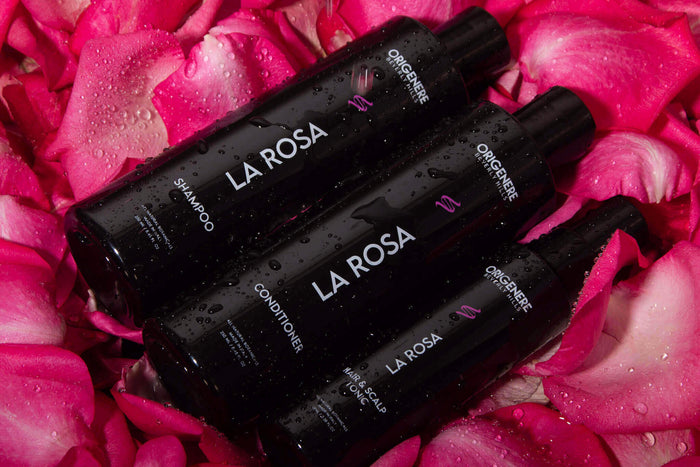
La Rosa is Origenere’s DHT-blocker-free, strand-focused pathway. Product connections below are limited to the current published ingredient lists and intended cosmetic roles; they do not borrow the outcomes of unrelated laboratory keratin systems.
La Rosa Nurturing Hair Shampoo
The current published INCI lists Hydrolyzed Keratin. In this rinse-off formula, it provides a strand-conditioning rationale alongside the shampoo’s gentle cleansing system.
Explore La Rosa Nurturing Hair ShampooLa Rosa Nurturing Hair Tonic
The current published INCI lists Hydrolyzed Keratin. As a leave-in product, the tonic provides a different cosmetic exposure than shampoo and is positioned around strand quality and healthier-looking hair.
Explore La Rosa Nurturing Hair TonicLa Rosa Nurturing Hair Conditioner
The current published INCI does not list Hydrolyzed Keratin. It remains relevant as a companion conditioner for softness, detangling and manageability—but should not be described as a keratin product.
Explore La Rosa Nurturing Hair ConditionerBotanical ritual
The La Rosa strand ritual: Cleanse wet hair gently with La Rosa Nurturing Hair Shampoo without aggressively rubbing the lengths together. Apply La Rosa Nurturing Hair Conditioner through the mid-lengths and ends, then rinse. Use La Rosa Nurturing Hair Tonic according to its directions as the leave-in step. Detangle from the ends upward and use the lowest effective heat when styling.
The objective is not to force the fiber into a fixed shape. It is to combine cleansing, conditioning and thoughtful care in a way that respects the condition and natural movement of the hair.

Frequently asked questions
What are the main benefits of keratin for hair?
Hydrolyzed keratin may temporarily improve smoothness, manageability, combing, surface feel and the appearance of compromised strands. The degree of benefit depends on the exact ingredient and finished formulation.
Does hydrolyzed keratin promote hair growth?
No direct human clinical evidence in the reviewed source set establishes topical hydrolyzed keratin as a hair-growth treatment. Its best-supported role is cosmetic care of the existing hair fiber.
Can keratin permanently repair damaged hair?
No. The visible shaft is nonliving and cannot biologically heal. Keratin-containing products may temporarily coat, condition or reinforce vulnerable areas, but cleansing and normal wear gradually reduce those effects.
Is hydrolyzed keratin the same as a Brazilian keratin treatment?
No. Hydrolyzed Keratin is a cosmetic conditioning ingredient used in products such as shampoo or tonic. Brazilian keratin smoothing is a professional process that may involve reactive chemicals, high heat and different safety concerns.
Which hair type may benefit most from hydrolyzed keratin?
Porous, bleached, chemically processed, weathered, curly or frequently styled hair may notice the greatest cosmetic improvement. Results remain formulation-dependent, and some fine or relatively intact hair may prefer less frequent protein use.
Which La Rosa products contain Hydrolyzed Keratin?
The currently published ingredient lists for La Rosa Nurturing Hair Shampoo and La Rosa Nurturing Hair Tonic include Hydrolyzed Keratin. The current public INCI for La Rosa Nurturing Hair Conditioner does not.
Final perspective
The credible benefits of keratin for hair are grounded in fiber science rather than follicle stimulation. Hydrolyzed keratin can provide a thoughtful formulation tool for improving how compromised strands feel, handle and reflect light.
The evidence also requires restraint. Experimental keratin systems vary widely, cosmetic improvement is generally temporary, and no reviewed human trial establishes ordinary topical hydrolyzed keratin as a treatment for hair loss.
Keratin can support the strand that already exists. It has not been shown to create the strand that does not.
References
- Fernandes C, Medronho B, Alves L, Rasteiro MG. On Hair Care Physicochemistry: From Structure and Degradation to Novel Biobased Conditioning Agents. Polymers. 2023;15(3):608. https://pmc.ncbi.nlm.nih.gov/articles/PMC9921463/
- Tsuda Y, Nomura Y. Properties of Alkaline-Hydrolyzed Waterfowl Feather Keratin. Animal Science Journal. 2014;85(2):180–185. https://doi.org/10.1111/asj.12093
- Basit A, Asghar F, Sadaf S, Akhtar MW. Health Improvement of Human Hair and Their Reshaping Using Recombinant Keratin K31. Biotechnology Reports. 2018;20:e00288. https://pmc.ncbi.nlm.nih.gov/articles/PMC6218806/
- Liu Y, et al. Enzymatic Crosslinking of Amino Acids Improves the Repair Effect of Keratin on Hair Fibre. Polymers. 2023;15(9):2210. https://pmc.ncbi.nlm.nih.gov/articles/PMC10180764/
- Li C, et al. Prevention of Hair Heat Damage via Thermoresponsive Organic Silicon-Modified Keratin. Molecules. 2026;31(3):521. https://pubmed.ncbi.nlm.nih.gov/41683497/
- Akanda MR, et al. Hair Growth Promoting Activity of Discarded Biocomposite Keratin Extract. Journal of Biomaterials Applications. 2017. https://pubmed.ncbi.nlm.nih.gov/28662599/
- U.S. Food and Drug Administration. Hair Smoothing Products That Release Formaldehyde When Heated. https://www.fda.gov/cosmetics/cosmetic-products/hair-smoothing-products-release-formaldehyde-when-heated
Leave a comment