



Pumpkin Seed Oil Benefits for Hair: Backed by Science

Botanical Brilliance
Pumpkin seed oil has something many botanical hair ingredients do not: direct human research. But the evidence is still limited, preparation-specific, and easy to overgeneralize. Here is what studies of pumpkin seed oil actually show—and why whole pumpkin seeds, pumpkin seed oil, and pumpkin seed extract should not be treated as the same ingredient.

Botanical identity
At-a-glance summary
- Human evidence exists. Oral pumpkin-seed-oil intervention has been studied in men with androgenetic alopecia, while topical pumpkin seed oil has been studied in women with female pattern hair loss.
- A 24-week male study reported approximately a 40% mean increase in hair count from baseline in the intervention group versus approximately 10% with placebo; measured hair thickness did not meaningfully differ between groups. [1]
- A three-month female clinical study reported favorable changes in hair-shaft diversity, vellus hairs, and upright regrowing hairs with topical pumpkin seed oil. [2]
- Pumpkin seeds, pumpkin seed oil, and pumpkin seed extract are different preparations. Evidence from one should not automatically be assigned to another.
- Pumpkin seed oil contains fatty acids, phytosterols, tocopherols, and other constituents, but proposed antioxidant and 5-alpha-reductase pathways should not be confused with proven clinical mechanisms in humans.
Meet the botanical
Pumpkins belong to the genus Cucurbita, a group of trailing or climbing plants in the Cucurbitaceae family. Kew recognizes Cucurbita pepo as an accepted species and describes its native range as a cultigen from Mexico. [8]
Its seeds are eaten as food and are also used to produce fixed seed oil and manufactured extracts. For hair research, however, those forms should not be collapsed into a single ingredient.
Pumpkin seeds
Whole pumpkin seeds contain protein, lipids, minerals, phytosterols, tocopherols, and other plant compounds. They are a nutrient-dense food, but the human hair studies discussed in this article did not test ordinary dietary pumpkin seeds. [6] [7]
Pumpkin seed oil
Pumpkin seed oil is the expressed lipid fraction of the seed. It contains a fatty-acid-rich matrix along with phytosterols, tocopherols, phenolic compounds, and other minor constituents. This is the preparation most directly connected with the published human hair research reviewed here. [5]
Pumpkin seed extract
Pumpkin seed extract is a processed ingredient whose composition depends on the extraction and standardization method. It is therefore not automatically equivalent to pumpkin seed oil, even though both originate from the same botanical.

Main bioactives and functional constituents
Pumpkin seed oil contains a mixture of lipids and minor botanical constituents. These help explain both its cosmetic formulation role and the scientific interest surrounding the oil, but individual constituents should not be treated as proof of a clinical hair outcome.
Science Behind Pumpkin Seed Oil Benefits for Hair
Interest in pumpkin seed oil and androgen-related hair loss is partly based on phytosterols and proposed 5-alpha-reductase activity. That is a plausible mechanistic rationale, but the human hair studies did not demonstrate that their observed outcomes were caused by a measured reduction in scalp or serum DHT.
Why does that matter for hair? 5-alpha-reductase is the enzyme that converts testosterone into dihydrotestosterone (DHT). In genetically susceptible hair follicles, DHT signaling contributes to progressive follicular miniaturization, producing increasingly finer, shorter hairs. Pumpkin seed phytosterols have therefore attracted interest for their potential interaction with this pathway. The proposed sequence is: phytosterols → possible 5-alpha-reductase inhibition → less DHT formation → potentially less androgen-driven pressure on susceptible follicles. This remains a proposed mechanism; human pumpkin seed oil studies have not demonstrated that DHT reduction caused the observed hair changes.

Historical and cultural context
Cucurbita is a New World genus. Historical botanical research describes it as native to the Americas and notes that it spread to other continents after European contact beginning in 1492. One of the earliest known European images of Cucurbita dates to 1503–1508. [9]
This chronology is important because pumpkins should not be retroactively assigned to ancient Greek, Roman, or pre-contact medieval European traditions. Later culinary and medicinal uses provide historical context, but tradition is not evidence that pumpkin seed oil treats hair loss.
What the science actually shows
Is Pumpkin Seed Oil Good for Hair Growth?
The most useful answer comes from separating the human research by population, preparation, and route.
Clinical Evidence and Human Studies
Hair, scalp, and strand relevance
Pumpkin Seed Oil for Female Hair Loss
Pumpkin seed oil is particularly interesting in women because there is direct topical human research rather than an inference based solely on male studies. In the 2021 randomized study, topical pumpkin seed oil was evaluated specifically in women with female pattern hair loss and produced favorable changes in several dermoscopic measures over three months. [2]
The study does not establish that pumpkin seed extract taken orally produces the same effects, that pumpkin seed oil corrects menopausal hormonal changes, or that it protects follicles by normalizing estrogen and DHT balance.
Topical vs. Oral Pumpkin Seed Oil: Benefits and Side Effects
Both routes have human research, but they have been studied under different conditions. Topical pumpkin seed oil was studied for three months in women with female pattern hair loss. The oral intervention was studied for 24 weeks in men with androgenetic alopecia. [1] [2]
The available evidence therefore does not tell us that one route is inherently “better,” and it does not establish that combining oral and topical use produces superior results.
Pumpkin Seeds Benefits for Hair
Pumpkin seeds provide protein, unsaturated fats, minerals, phytosterols, tocopherols, and other compounds as part of the diet. [6] [7]
That makes them a nutrient-dense food. It does not mean that eating pumpkin seeds has been clinically demonstrated to reproduce the hair outcomes observed with the specific pumpkin-seed-oil interventions studied in humans.
Pumpkin Seed Extract Benefits
Pumpkin seed extract deserves its own category because extraction can change which compounds are concentrated and in what proportions.
When evaluating an extract, useful questions include the extraction method, standardization, amount used, route, accompanying ingredients, and whether that exact preparation has been studied. The words “pumpkin seed” on two ingredient labels do not establish biological equivalence.
Pumpkin Seed Oil vs. Pumpkin Seeds for Hair Growth
Pumpkin seeds are a whole food. Pumpkin seed oil is the lipid-rich fixed oil expressed from those seeds. Pumpkin seed extract is a processed preparation whose composition depends on how it is produced.
Of those forms, pumpkin seed oil currently has the clearest direct human hair evidence in the literature reviewed for this article. That does not establish that the other forms are ineffective; it means their evidence should be judged separately.
Scalp and strand relevance
Pumpkin seed oil’s lipid profile provides a straightforward cosmetic rationale for conditioning dry-feeling hair and scalp and improving slip and softness. These strand and formulation effects should remain distinct from claims of follicle stimulation or treatment of an inflammatory scalp disorder.
What has not been proven
- Pumpkin seed oil has not been proven to be “nature’s finasteride.”
- The human hair studies do not prove that pumpkin seed oil lowers DHT in the scalp or bloodstream.
- Pumpkin seed oil, whole pumpkin seeds, and pumpkin seed extract have not been established as interchangeable hair-growth interventions.
- The available evidence does not establish that combining oral and topical pumpkin seed products works better than either route alone.
- The female trial does not by itself establish that pumpkin seed oil is universally equivalent to 5% minoxidil.
- Pumpkin seed oil has not been proven to correct pregnancy-, perimenopause-, or menopause-related hormonal changes.
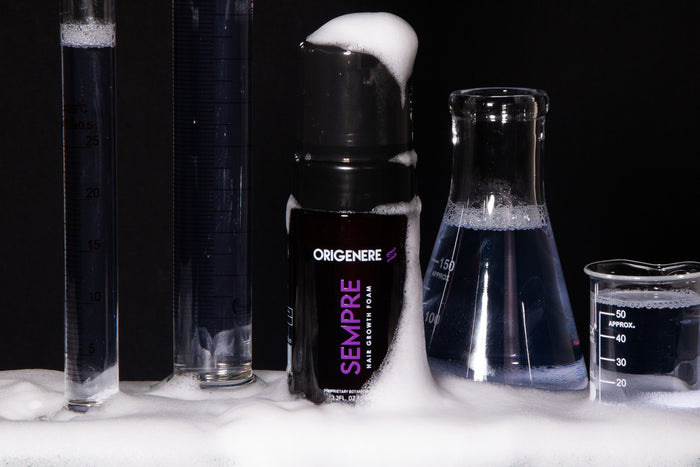
- The pumpkin seed oil studies discussed here did not evaluate Origenere Sempre Hair Growth Organonutrients or its finished formulation.
Safety and appropriate use
Within the Origenere system
For readers looking for a daily oral formula that includes pumpkin seed extract, Sempre Hair Growth Organonutrients - Hair & Skin Vitamins combines it with a broader blend of botanical ingredients, vitamins, minerals, and plant sterols.

Sempre Hair Growth Organonutrients - Hair & Skin Vitamins
Pumpkin seed extract is included as one ingredient within Origenere’s broader Sempre internal-support formula. Its inclusion represents a formula-specific botanical rationale rather than a transfer of the clinical outcomes reported for pumpkin seed oil.
Shop Sempre Hair Growth Organonutrients →Botanical ritual
A simple pumpkin seed oil pre-shampoo ritual
Warm a small amount of cosmetic-grade pumpkin seed oil between your palms and smooth it lightly through dry mid-lengths and ends.
Leave it on for approximately 10–20 minutes, then shampoo normally. If you want to use it on the scalp, patch-test first and begin with a small area. Avoid applying oil to broken, infected, or actively irritated skin.
The goal is straightforward: conditioning, slip, and a more comfortable cosmetic feel—not a promise of follicle stimulation.

Frequently asked questions
Does pumpkin seed oil help with hair growth?
There is encouraging human evidence. A 24-week randomized placebo-controlled study in men reported a larger increase in hair count with an oral pumpkin-seed-oil intervention, while a separate three-month randomized study in women reported favorable dermoscopic changes with topical pumpkin seed oil. The total evidence base remains relatively small, so pumpkin seed oil is better described as promising than universally proven. [1] [2]
What are the benefits of pumpkin seed oil for hair?
Pumpkin seed oil has two different types of relevance. Specific oral and topical preparations have preliminary human hair evidence, while its fatty-acid-rich composition also provides a formulation rationale for conditioning hair and scalp. Those cosmetic properties should be distinguished from claims of clinical follicle stimulation.
Is topical or oral pumpkin seed oil better for hair growth?
We do not know. Topical and oral pumpkin seed oil have been studied in different populations, for different durations, and with different study designs. The studies reviewed here do not directly compare the two routes or prove that combining them produces better results.
Pumpkin seed oil vs. pumpkin seeds: which is better for hair?
They are different preparations. Whole pumpkin seeds are nutrient-dense foods, while pumpkin seed oil is the extracted lipid fraction and is the form with the clearest direct human hair evidence in the literature reviewed here. There is not enough evidence to say that eating ordinary pumpkin seeds produces the same hair outcomes.
What does the 400 mg pumpkin seed oil hair-growth study actually show?
In the 2014 randomized study, men assigned to an intervention described as providing 400 mg of pumpkin seed oil per day had a mean hair-count increase of approximately 40% from baseline after 24 weeks, compared with approximately 10% in the placebo group. Hair thickness did not show a corresponding advantage. The intervention used Octa Sabal Plus®, so the finding should remain tied to that studied intervention rather than generalized to every pumpkin seed oil, extract, or supplement. [1]
Does pumpkin seed oil block DHT?
5-alpha-reductase and DHT modulation are proposed mechanisms behind scientific interest in pumpkin-derived phytosterols. However, the human hair studies discussed here did not demonstrate that their observed hair outcomes resulted from measured DHT reduction. DHT modulation is therefore better described as a mechanistic rationale than as a proven human effect from these trials.
What are pumpkin seed oil side effects?
Pumpkin seed oil was generally well tolerated in the published male study, although individual mild complaints occurred. Topical products can also cause irritation or allergy in some people. Safety depends on route, dose, formulation, and the person using it. [1]
Is pumpkin seed oil safe during pregnancy or breastfeeding?
Food amounts of pumpkin seeds and concentrated pumpkin seed oil or extract supplements are not equivalent. Because safety data for concentrated preparations during pregnancy and breastfeeding are limited, supplementation should be discussed with a healthcare professional rather than relying on assumptions about hormonal or DHT effects.
Final perspective
Pumpkin seed oil occupies an interesting place in botanical hair research because it has moved beyond purely traditional or laboratory evidence. There is randomized human research involving an oral intervention in men, randomized topical research in women, supportive animal evidence, and a plausible phytosterol and lipid-chemistry story. [1] [2] [3]
But that does not turn every pumpkin-derived ingredient into the same intervention. Whole seeds are not seed oil. Seed oil is not pumpkin seed extract. A branded oral intervention is not a topical oil. And none of these studies automatically establishes the effects of a finished multi-ingredient product.
The most useful way to understand pumpkin seed oil benefits for hair is neither to dismiss the research nor exaggerate it: the human signal is promising, the forms matter, and better replication would make the answer considerably stronger.
Interested in the pumpkin seed extract used in Sempre? Explore the full Organonutrients formula →
References
- Cho YH, Lee SY, Jeong DW, et al. Effect of pumpkin seed oil on hair growth in men with androgenetic alopecia: a randomized, double-blind, placebo-controlled trial. Evidence-Based Complementary and Alternative Medicine. 2014;2014:549721. doi:10.1155/2014/549721. PubMed
- Ibrahim IM, Hasan MS, Elsabaa KI, Elsaie ML. Pumpkin seed oil vs. minoxidil 5% topical foam for the treatment of female pattern hair loss: A randomized comparative trial. Journal of Cosmetic Dermatology. 2021;20(9):2867–2873. doi:10.1111/jocd.13976. PubMed
- Hajhashemi V, Rajabi P, Mardani M. Beneficial effects of pumpkin seed oil as a topical hair growth promoting agent in a mice model. Avicenna Journal of Phytomedicine. 2019;9(6):499–504. doi:10.22038/AJP.2019.13463. PubMed
- Drake L, Reyes-Hadsall S, Martinez J, et al. Evaluation of the Safety and Effectiveness of Nutritional Supplements for Treating Hair Loss: A Systematic Review. JAMA Dermatology. 2023;159(1):79–86. doi:10.1001/jamadermatol.2022.4867. PubMed
- Wargala E, Chrzanowska A, Bernatek-Samoraj W, Kot I. Pumpkin (Cucurbita pepo L.) seed oil – cosmetic, food and medical raw material. Herba Polonica. 2023;69(3):7–14. Source
- Gavril Rațu RN, Stoica F, Lipșa FD, et al. Pumpkin and Pumpkin By-Products: A Comprehensive Overview of Phytochemicals, Extraction, Health Benefits, and Food Applications. Foods. 2024;13(17):2694. doi:10.3390/foods13172694. PubMed
- Aziz A, Noreen S, Khalid W, et al. Pumpkin and Pumpkin Byproducts: Phytochemical Constitutes, Food Application and Health Benefits. ACS Omega. 2023;8(26):23346–23357. doi:10.1021/acsomega.3c02176. PMC
- Royal Botanic Gardens, Kew. Plants of the World Online: Cucurbita pepo L. Botanical identity and distribution. Kew Science
- Paris HS, Daunay MC, Pitrat M, Janick J. First known image of Cucurbita in Europe, 1503–1508. Annals of Botany. 2006;98(1):41–47. doi:10.1093/aob/mcl082. PubMed
K, thank you for your comment! Pumpkins are native to MesoAmericas! and subsequently introduced to Europe in the 1600s where one of the many uses was for urinary symptoms. I can see how above was ambiguous. For clarity, pumpkins originated to MesoAmerica with subsequent travel to Europe. Isnt the power of observation an amazing thing, ability to find therapy from observation predated modern science. Extraordinaary. Source: https://pubmed.ncbi.nlm.nih.gov/16687431/
Pumpkins are native to the Americas and were the early colonizers the ones that brought them to Europe so the Historical use section about Rome and Ancient Greece using pumpkin seeds is false.
Leave a comment