



Unlocking the Secret: Finding Hair Growth Pills That Actually Work

What’s In Your Bottle? / The selection guide
Comparing the best hair growth supplements means looking past the front label. Start with your goal, the complete formula, what clinical research measured, and whether the product fits your health and routine.
Do hair growth supplements actually work?
Some nutritional supplements have encouraging clinical studies, including in people without a documented vitamin deficiency. A systematic review identified potential benefits for specific products and ingredients, alongside study limitations and a need for stronger trials. It does not follow that every formula supports hair regrowth, increased hair density, or thicker hair. [1]
The useful question is: does this formula make sense for me? Use the checks below to compare serving sizes, preparations, evidence, and ongoing cost.
Choose the purpose before the product
Hair shedding, gradual hair thinning, and patchy hair loss are not necessarily the same condition. Causes can include nutritional deficiencies, changes in the hair growth cycle, androgenetic alopecia (pattern hair loss), or alopecia areata. The first step is understanding the type of hair loss with a healthcare provider when symptoms persist, progress, or appear suddenly. A targeted nutrient replacement, a daily hair supplement, and prescription medications serve different roles. [2]
A specific nutritional need
Address the actual shortfall
If testing and clinical assessment identify iron deficiency, low vitamin D levels, or zinc deficiency, a healthcare professional can recommend appropriate management. A broad formula does not replace deficiency-specific care, and thinning hair alone is not a reason for high-dose supplementation. [2]
A broader daily formula
Evaluate the combination
For a blend that includes biotin, vitamins, minerals, fatty acids, or botanicals, compare the full daily serving with your diet and other supplements. Nutrients are important for normal hair and overall health, but their presence does not prove that a specific blend improves hair density or hair quality. [3]
Need the ingredient-by-ingredient background first? Our natural hair growth vitamins guide explains vitamins, minerals, and botanicals. This page focuses on choosing between complete products.
How to choose the best hair growth supplements: six label checks
Read the Supplement Facts and the other-ingredients list—not just the front label. Serving size and amounts per serving are fundamental to a fair comparison. [4]
Daily serving
Check the directions alongside the capsule count. A hypothetical bottle containing 60 capsules lasts 30 days at two capsules daily—not 60 days. Compare products at their directed daily use.
Dose, units, and daily allowances
Read the amount per full serving: milligrams (mg), micrograms (mcg), and, for vitamin D on some labels, international units (IU) are not interchangeable. Percent Daily Value is a labeling reference, not proof a product meets your personal recommended dietary allowance or treats hair loss. Watch for overlapping or high doses in other products. [5] [11]
Ingredient forms
Look for the plant part and preparation: root powder, leaf extract, or fixed seed oil. Extraction changes what a preparation contains; similar plant names do not establish equivalent products. [6]
Blend transparency
When a proprietary blend lists only a combined weight, that total does not reveal each ingredient’s amount. Ask the manufacturer for details needed to evaluate a specific claim; do not guess the individual dose. [4]
Safety and side effects
Check capsule materials, other ingredients, warnings, and storage directions. Consider side effects, allergies, and potential interactions with prescription medications. “Natural” or “extra strength” does not mean a supplement is suitable for everyone. [3] [4]
A practical routine
Choose a format and schedule you can follow. Confirm how many capsules or gummies make a serving, how long the supply lasts, and how you will reassess the purchase. Convenience is useful; it is not proof of efficacy.
What does “backed by science” actually refer to?
Before accepting “clinically studied” or “supports healthy hair growth,” request the clinical research and check four things: the preparation, daily dose, people studied, and measured outcome. A topical study of pumpkin seed oil does not prove the effects of an oral pumpkin seed extract, and a trial of a different formula is not a trial of the product you are buying. [3] [6]

Compare the source
Hair supplements with silica
Check which silicon preparation was studied and which appears on the label. Our bamboo guide walks through that comparison.
Explore bamboo & silica →
Compare the preparation
Powder, extract, or oil?
A familiar plant can appear in very different forms. Use the moringa guide to examine preparation and route before transferring a research claim.
Explore the moringa guide →Check what improved. Changes in hair density or hair count, measured shaft thickness, hair shedding, hair quality, and participant-reported fullness are different outcomes. A study reporting shinier or healthier-feeling hair has not necessarily shown new hair regrowth. Consider comparison groups, follow-up duration relative to the hair growth cycle, and whether findings were reproduced. Do not treat one positive study as a promise of visible results for everyone. [1]
Quality testing and clinical results answer different questions
Independent quality testing can help assess whether a supplement contains its labeled ingredients and meets contamination standards. It does not, by itself, prove that the product grows hair or is suitable for you. Verify any testing or certification claim for the exact product. [5]
Dietary supplements are not FDA-approved for safety and effectiveness before sale in the way medicines are. Treat “FDA-approved supplement” language as something to question, not a shortcut to choosing a product. [4]
Compare cost per day, not just bottle price
Once the formula and suitability make sense, compare the ongoing purchase on equal terms.
A simple comparison
Cost per day = product cost after discounts ÷ days of supply at directed use
For a fuller comparison, account for shipping, taxes, and any subscription renewal price. A larger pack or introductory discount is only useful when the purchase fits your needs and budget.
Read delivery frequency, cancellation terms, and whether the renewal offer differs from the first purchase. An economical supply is not a reason to continue a product that is unsuitable.
Apply the same checks to our formula
A closer look at Sempre
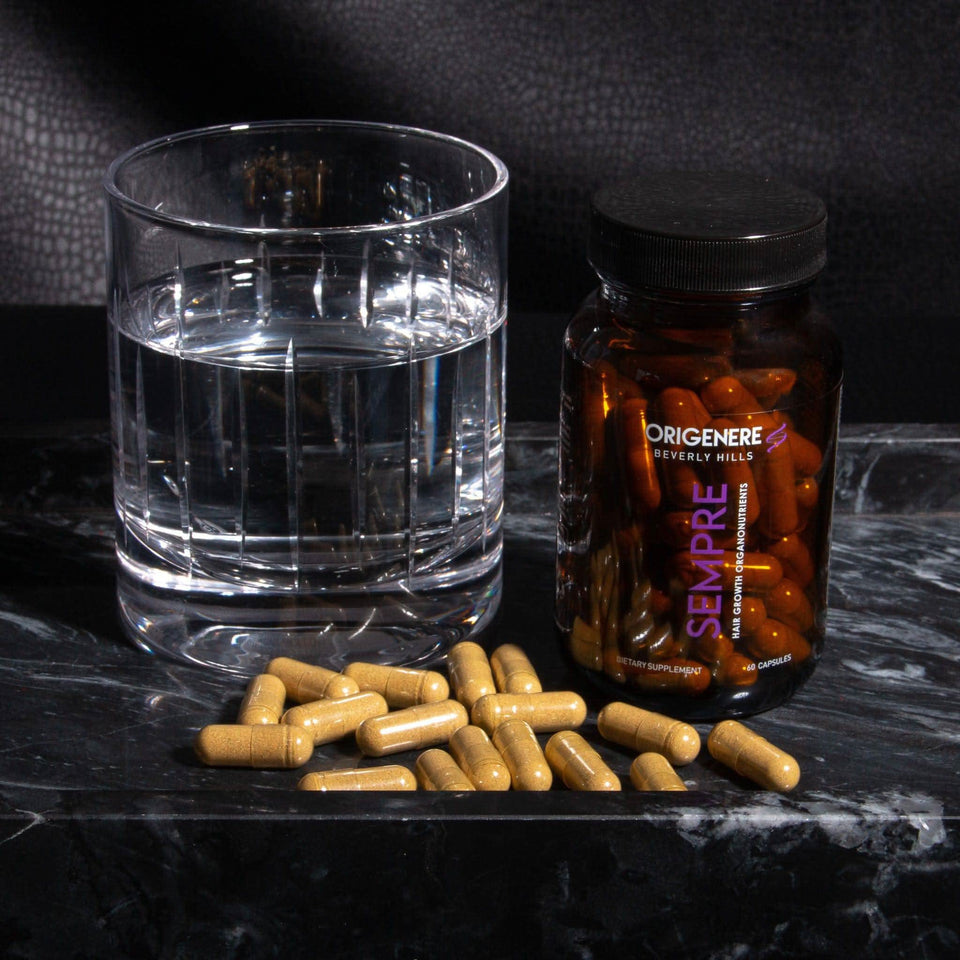
Sempre Hair Growth Organonutrients is Origenere’s oral vitamin, mineral, and botanical formula for people comparing hair health supplements. Its published ingredients include saw palmetto, pumpkin seed extract, bamboo extract, moringa powder, ashwagandha root powder, and turmeric powder. [8]
The current directions specify two capsules daily with water. Confirm the Supplement Facts and instructions on your packaging, and review the complete formula against the checks above. [8]
Use the product page for current supply options and purchasing terms. Ingredient research discussed here should not be read as a clinical trial of the finished Sempre formula.
Before you add it to your routine
Review a new supplement with a clinician or pharmacist when you take medicines, have a medical condition, or are preparing for surgery. Bring the full label and your existing supplement list; “natural” does not rule out interactions or side effects. [3]
Tell your clinician and laboratory about biotin before blood tests and follow their test-specific instructions. Do not stop prescribed medicines to replace them with a supplement. [7] [5]
Questions when comparing hair supplements
What are the best hair growth supplements for women?
There is no single formula that is the best match for every woman. Start with the reason for hair changes, relevant nutritional needs, medications, and pregnancy or breastfeeding status. Compare the evidence for the actual product rather than treating “for women” as a guarantee of suitability. [2] [3]
Are gummies better than capsules?
Do not rank a product by format alone. Compare the full daily serving, ingredients, amounts, other ingredients, and the evidence for that particular formula. Then choose a format you can use as directed. Check the label rather than assuming equivalent products.
Is biotin alone enough?
Not necessarily. Biotin deficiency is uncommon, and evidence that extra biotin improves hair health in people without deficiency is limited. A high dose does not tell you whether shedding comes from low nutrient intake, pattern hair loss, or another cause. Biotin can interfere with some laboratory tests. [7]
How long should I assess a supplement before deciding?
Use a product-specific plan rather than expecting one universal timeline. Sempre’s published guidance suggests at least three months of consistent use before assessing visible changes; that is a review interval, not a promised outcome. Do not wait on a supplement when hair loss is sudden, patchy, or worsening. [8] [2]
Can I take a hair supplement with a multivitamin?
Compare both labels first. Adding products can duplicate nutrients, and higher combined intake is not automatically better. A clinician or pharmacist can assess whether the combination is appropriate rather than assuming both belong in your daily routine. [5]
Should I choose a vitamin D, iron, or zinc supplement instead of a hair-growth blend?
It depends on whether a specific deficiency has been documented. Vitamin D deficiency, iron deficiency, and low zinc intake have different causes, tests, and appropriate dosing considerations. A clinician can interpret your history and any relevant results; taking more of all three nutrients is not a general hair-regrowth strategy. For individual nutrient roles, visit our vitamins for hair growth guide. [11] [12] [13]
Will the best vitamins for hair growth also treat pattern hair loss or alopecia areata?
No supplement should be assumed to treat every type of hair loss. Androgenetic alopecia and alopecia areata have different mechanisms and medical management options. A formula may supply essential nutrients, but it is not a substitute for diagnosis, prescription treatment where indicated, or follow-up with a healthcare provider. [2]
Make the next step an informed one
Know why you are choosing a supplement. Read the full serving. Match the evidence to the preparation. Compare ongoing cost. Then decide whether the product fits your routine.
Sources & further reading
- Drake L, et al. Evaluation of the Safety and Effectiveness of Nutritional Supplements for Treating Hair Loss: A Systematic Review. JAMA Dermatology. 2023;159:79–86. Read the review.
- American Academy of Dermatology. Hair loss: diagnosis and treatment.
- National Center for Complementary and Integrative Health. Using dietary supplements wisely.
- U.S. Food and Drug Administration. Questions and answers on dietary supplements.
- NIH Office of Dietary Supplements. Dietary supplements: what you need to know.
- NIH Office of Dietary Supplements. Botanical dietary supplements: background information.
- NIH Office of Dietary Supplements. Biotin: consumer fact sheet.
- Origenere. Sempre Hair Growth Organonutrients: ingredient list and product guidance. Refer to current packaging for Supplement Facts and directions.
- National Center for Complementary and Integrative Health. Saw palmetto: usefulness and safety.
- National Center for Complementary and Integrative Health. Ashwagandha: usefulness and safety.
- NIH Office of Dietary Supplements. Vitamin D: fact sheet for health professionals. Nutrient units, status, and reference intakes.
- NIH Office of Dietary Supplements. Iron: fact sheet for health professionals. Iron status and intake.
- NIH Office of Dietary Supplements. Zinc: fact sheet for health professionals. Zinc status and intake.
Published by Origenere, which offers Sempre Hair Growth Organonutrients. This is an educational selection framework, not an independent brand ranking or an individual treatment recommendation. Cited sources do not constitute an endorsement of Sempre. Dietary supplements are not intended to diagnose, treat, cure, or prevent disease.
Leave a comment